

One of the most influential composers of our time, who is called a “living legend of minimalism.” His music influenced not only the academic tradition, but also popular culture, cinematography and even the mass consciousness of listeners in the second half of the 20th – beginning of the 21st century. Further on chicago1.one.
Biography
Philip Glass was born on January 31, 1937 in Baltimore, USA. His father, the owner of a small music store, often brought home records that did not sell, and it was thanks to this that the future composer was able to listen to a wide variety of recordings – from classical music to modern experimental works. This environment shaped his openness to different musical styles. At the age of six, the boy began learning the violin, and later mastered the flute and keyboard instruments. Having shown his abilities very early, he began to seriously get interested in composition and sought for broader knowledge than he could get in his hometown.
Already at the age of 15, Glass entered the University of Chicago, where he studied mathematics and philosophy. Studying here became a decisive stage in his formation: he discovered an intellectual environment saturated with new ideas, had access to concerts of the Chicago Symphony Orchestra, visited jazz clubs and got acquainted with avant-garde literature. After graduating from the university, Glass continued his musical education at the Juilliard School in New York, where he specialized in composition. There he got acquainted with modern musical trends and received an academic education.
In the 1960s, he went to Paris, where he became a student of the famous teacher Nadia Boulanger, who taught many outstanding artists of the 20th century. Under her guidance, Glass delved into the tradition of European classics, mastered the strict methods of polyphony and harmony, which he later combined with his own search for new musical forms. A decisive moment in the formation of his style was the collaboration with the Indian musician Ravi Shankar. This acquaintance opened up a completely different world of musical thinking to him, which later became the basis for his own style – minimalism.
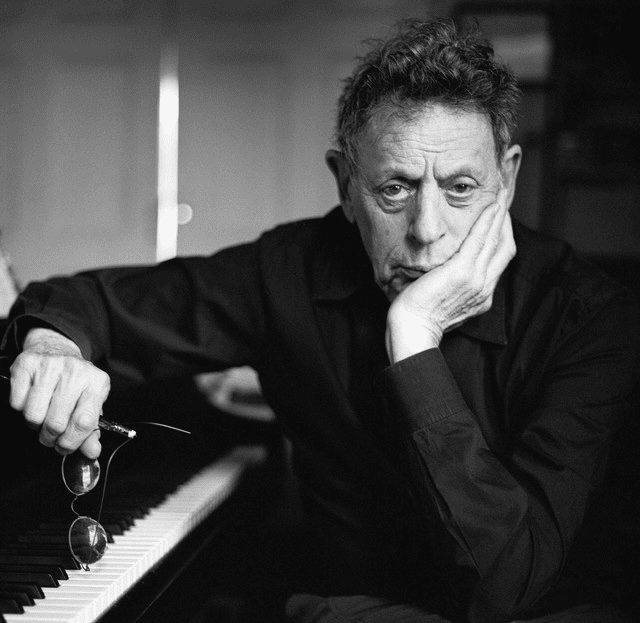
Minimalism
Philip Glass became one of the leading representatives of musical minimalism along with Steve Reich, Terry Riley and LaMonte Young. This style was formed in the 1960s as a counterpoint to the academic avant-garde, which tended toward excessive complexity, which often alienated listeners from the music. Minimalists strove for simplicity, clarity and direct emotional impact.
Glass’s style is based on several characteristic elements:
- repetition of short musical phrases, which create a feeling of continuous movement;
- gradual changes in harmony and rhythm, which unfold slowly, creating the effect of a gradual “shift”;
- a hypnotic, meditative atmosphere that immerses the listener in the sound space and causes a feeling of a “musical trance”.
The peculiarity of the author lies in the fact that his music retains a complex architectonics and internal logic, but at the same time is extremely accessible to a wide audience. He abandoned experiments and created a style that combines intellectual depth with emotional expressiveness. The musician’s minimalism was influenced not only by the Western tradition, but also by Indian classical music, with which the composer became acquainted thanks to Ravi Shankar. Hence the characteristic use of cyclical rhythmic structures, long sound flows and repetitions that resemble mantras. His creative method is often described as “musical geometry”, where even the smallest shifts in harmony or rhythm have great importance. As a result, the effect of constant development arises, although it may seem to the listener that the music “is standing still”. Critics sometimes reproached him for monotony, but this feature became his strength: he created a new musical experience, in which not so much the melody or traditional form is important, but the temporal experience of sound.
Glass’s style went far beyond the classical scene. Its influence can be heard in film music, theatrical productions, pop and rock music. The composer himself has repeatedly emphasized that his goal was to make modern academic music understandable, emotional, and one that speaks to a wide range of listeners.
Main works
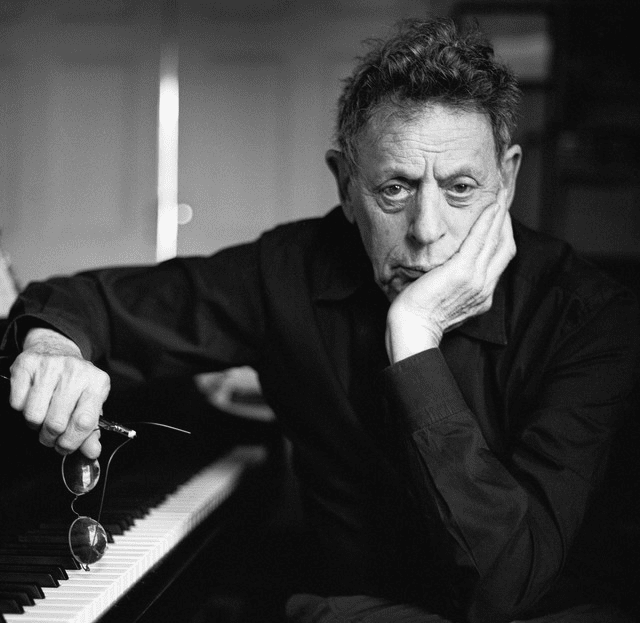
Philip Glass left behind a huge and diverse body of work: more than 25 operas, 12 symphonies, dozens of concertos, chamber and vocal compositions, as well as numerous works for theater and film. His music formed a new aesthetic of the second half of the 20th century and continues to influence the present.
A special place in Glass’s work is occupied by opera. He sought to restore the genre in a modern context, making it more accessible to viewers. “Einstein on the Beach” (1976) is an experimental opera created in collaboration with director Robert Wilson. The work lasts about five hours and does not have a traditional plot or linear action. Instead, it offers a musical and visual meditation on the image of Einstein, his ideas and influence on the 20th century. This opera was a breakthrough in world musical theater.
Glass wrote a number of symphonies that demonstrated his ability to work with large forms:
- Symphony No. 1 “Low” (1992) and Symphony No. 4 “Heroes” (1996) – created based on the music of David Bowie and Brian Eno, which testified to his openness to pop culture;
- Symphony No. 5 (1999) is a grandiose work in 12 parts dedicated to the beginning of the new millennium. It combines texts from various world religions and philosophical traditions, creating a kind of “musical encyclopedia of spirituality”;
- late symphonies, in particular No. 11 (2017), demonstrate the composer’s mature style, in which meditativness and dramatic expression are combined.
Glass created numerous chamber ensemble works, among which the String Quartets (there are nine of them) occupy a special place. These works combine the intensity of rhythm with subtle harmonic work, and are one of the most performed parts of his heritage. One of the most famous facets of Glass’s activity is his work in cinema. He wrote music for many cult films:
- “Koyaanisqatsi” (1983) – the first part of “Qatsi Trilogy”, an experimental film by Godfrey Reggio, where Glass’s music became an equal hero along with visual images;
- “The Hours” (2002) – a dramatic and poignant soundtrack that earned the composer an Oscar nomination and a BAFTA award;
- “Kundun” (1997) – a film by Martin Scorsese;
- “The Truman Show” (1998) – where Glass’s music emphasized the idea of absurdity and at the same time the poetic nature of life in an artificial world;
- “Notes on a Scandal” (2006) – a psychological thriller, where his score creates a tense emotional atmosphere.
In addition, his music was used in numerous documentary and independent films, which made it recognizable even to those who are not familiar with the composer’s academic work. Glass actively worked with theatrical productions, created music for dance performances, in particular in cooperation with choreographers Lucinda Childs and Twyla Tharp. His compositions for dance have become classics of modern choreography.
Cooperation with the art world
Philip Glass’s music goes far beyond the academic scene. He always sought a dialogue between different types of art, combining classics with pop culture, cinema, theater and visual experiments.
His works were performed on the biggest stages of the world: from the Metropolitan Opera in New York to the festival in Salzburg. He also collaborated closely with theater directors, in particular with Robert Wilson (“Einstein on the Beach”), which became a classic of modern musical theater. Thanks to these collaborations, Philip Glass went beyond the framework of “a composer for the chosen ones” and became a real cultural phenomenon. His music sounded equally natural both in the opera house, and on the rock stage, and on the movie screen, which made his influence global.
Sources: